Final Fantasy Adventure
Developer : Square
Publisher : Square
Platform : Game Boy
Release Year : 1991
The Start of Something Special
Thanks to my Miyoo-Mini+, I am checking out a whole bunch of Game Boy games I never played back in the day. Some of the games are ones I’ve never heard of, like the title we are going to explore today, while others are those so called ‘hidden gems’ only a few have heard of. To start this retro adventure and journey through the past, I am going through some of the Final Fantasy games for the GB, which all happen to be Final Fantasy in name only in North America, while being their own series in Japan.
Known as Seiken Densetsu: Final Fantasy Gaiden in Japan, or simply just Seiken Densetsu, Final Fantasy Adventure is a wonderful action-roleplaying game for the original Game Boy, and the first game in the wonderful Mana series. I never played this game as a kid, nor did I know that it was the game that came before Secret of Mana back then, but I do remember seeing it in Nintendo Power and thinking that it looked like a good bit of fun. After playing through this title, the first of the Mana games, I can see why it is regarded as one of the best, if not THE best, action-rpgs on the Game Boy: the combat is fun and varied, with all of the different weapon types being used in unique ways to get around the world; the story is a bit more involved than a lot of other Game Boy titles, which is really impressive for a handheld game from 1991; and the graphics and visual design are fantastic, and they’re laying the ground work for the beautiful visuals that the Mana series is known for.
Gameplay
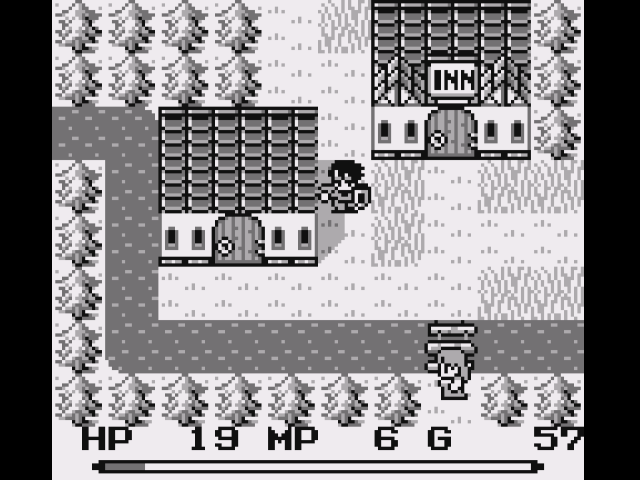
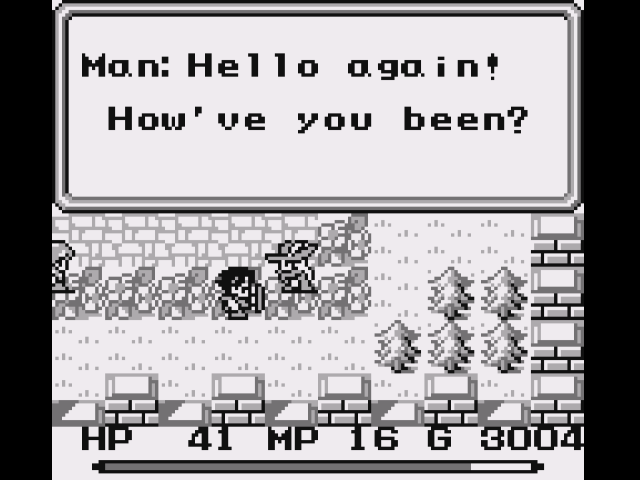
Seiken Densetsu is an action-rpg that plays somewhat like a Zelda game but very much forges its own unique path and identity. The adventure unfolds from a top-down perspective with you explore the world, screen by screen, battling monsters, finding treasure, talking with townsfolk, and leveling up. It’s pretty standard stuff but done with style and a confidence that shows the team had a real vision for the game they wanted to make.
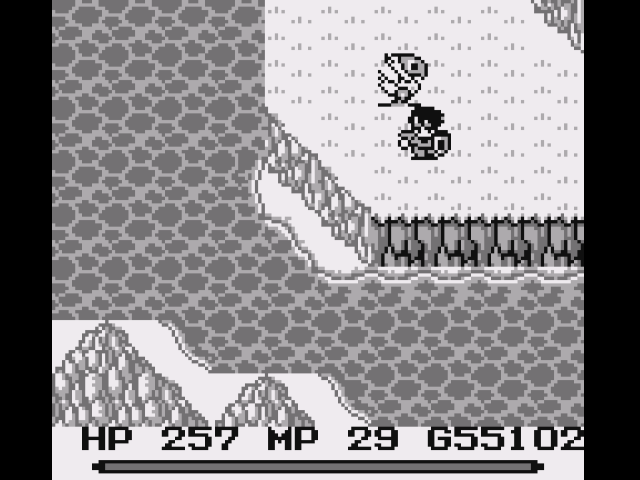
The game’s combat and weapon system are so cool, and together they make exploring the game’s world and battling the game’s enemies a real joy. There are two ways these systems stands on their own: the first is the power gage at the bottom of the screen, which determines the strength of your strikes; and the second is that the weapons you collect during your journey interact with the world and enemies in a variety of different ways, from clearing the way ahead to certain weapons being effective against certain monsters. While these mechanics would all be pretty standard fare today, I think back in the early, early ‘90s, these would have been really unique; hell, they’re still unique and make the game play and feel unlike most other action-rpgs I have played/seen on the Game Boy.
The power gage at the bottom of the screen, which refills after every swing of your weapon, gives Final Fantasy Adventure a bit of a turn-based feel. You can totally swing wildly, but it is far better to let the bar refill before each swing to maximize your damage. Plus, attacking when the power gage is maxed fires off a special move that is unique to each type of weapon. Each weapon type also interacts with the world in unique ways, from axes chopping down trees, to whips getting you over gaps, and scythes clearing away the undergrowth. This specialization also extends to the types of monsters each weapon is effective against, making which weapon you select involve more than just which hits the hardest; it’s nice having to think about what weapon you need for each situation.
Now on the other hand, while the combat and weapon mechanics in this game are really cool, and a lot more involved that most other action-rpgs on the Game Boy, it is taking off more than it can chew. The idea of constantly changing your weapon to account for the situation is a good one, but only having four buttons to work with slows the whole thing down. Having to pause the game, open a menu, scroll to the weapon you want, equip it, close the menu, and get back into the action is a lot, and it slows the action down to a crawl at times. It’s not a deal breaker by any stretch of the imagination, but it is a blemish on what is otherwise an awesome combat system.
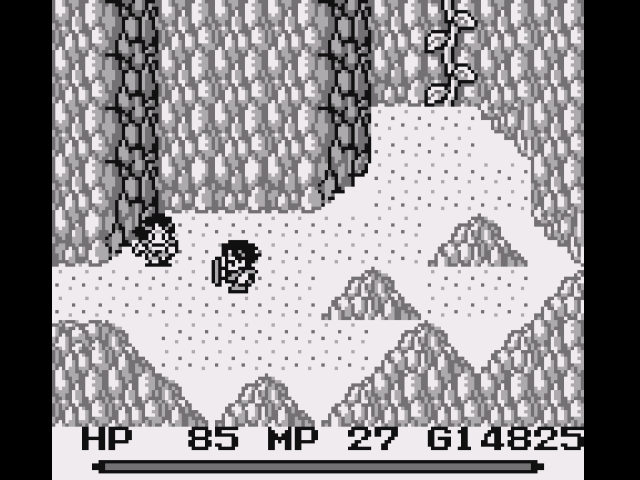
Another cool thing that is held back by its rocky implementation is this game’s party system. Here and there you will be joined by a companion during your travels, usually in a dungeon, who will ‘help’ you. Help being a strong word, because more often than not, your party member will wander around aimlessly while shooting their projectiles every which way. What your comrades lack in combat prowess, they make up for in their utility by either restoring your HP, restoring your mana, or healing you of any status ailments. You quickly learn that this utility is the only thing they are good, and that when it comes to combat, your party members are less than useless.
The magic system here is pretty by the numbers, which I feel is a good thing. Square tired something different and new with the weapons and melee combat, so having a straightforward magic system is nice. You’ll be able to heal yourself of status ailments and restore your HP with curative spells, and damage enemies with fireballs, icicles, bolts of lighting, and even the power of nuclear energy! You will also use your spells to solve a puzzle here and there, and there are a few enemies that can only be defeated by certain spells, you know, pretty standard magic system stuff.
Presentation
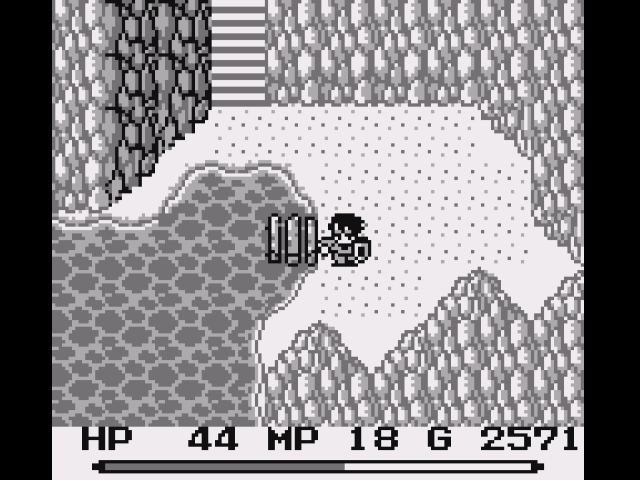
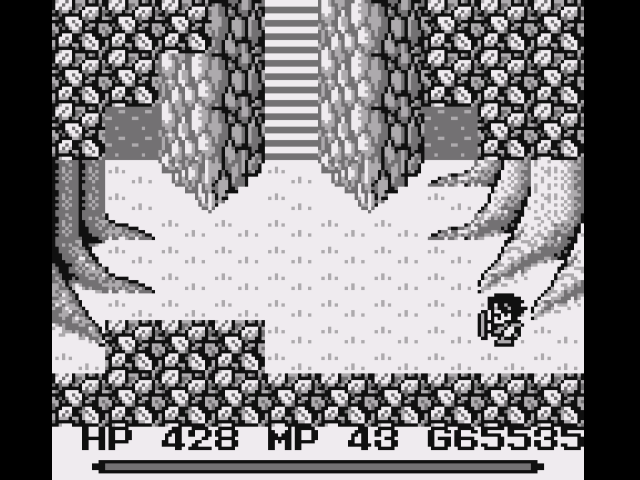
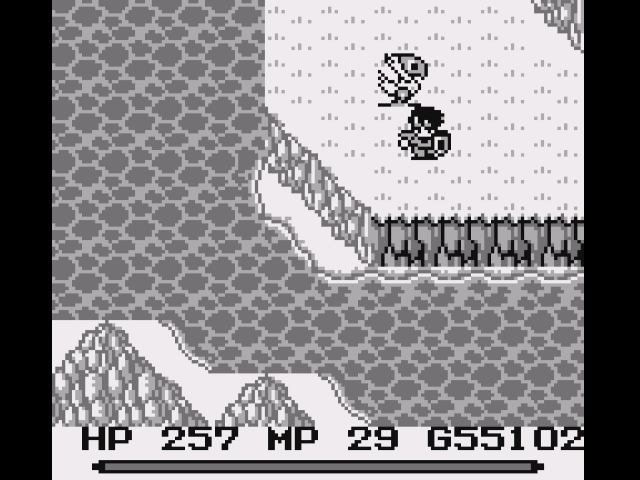
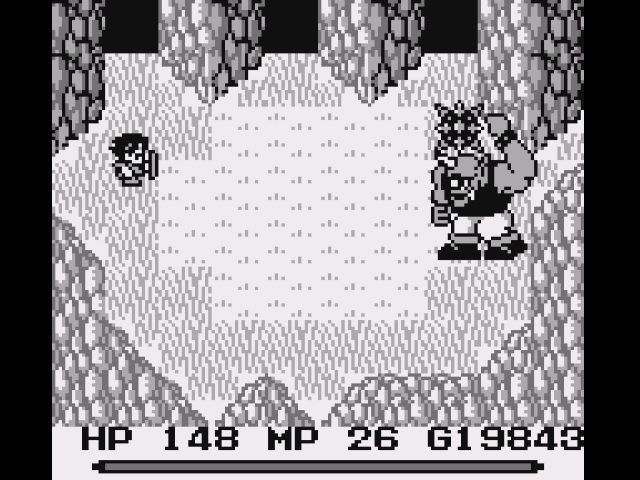
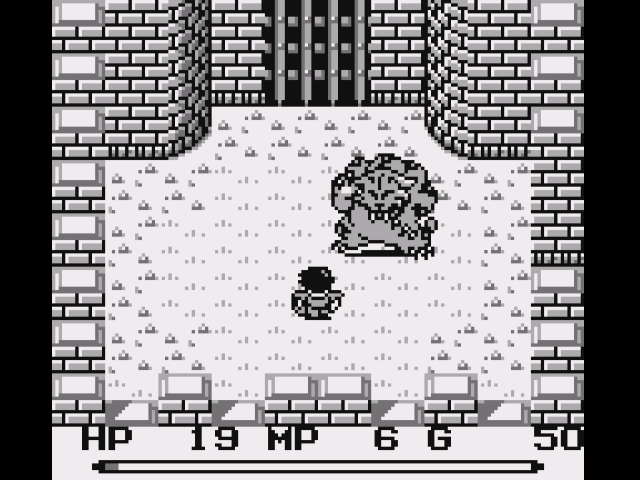
The visuals here are quite good for such an early Game Boy title. The sprite work is great, with the monsters and the bosses being real stand outs. A lot of familiar enemies that appear in the Mana games got their start here, like the Rabites, and there are also some Final Fantasy staples here, like Moogles and Chocobos, which highlight the fact that this game started as a side game in the Final Fantasy series. The game world looks nice and has a healthy variety of places to visit and explore during your adventure, ranging from deserts, to forests, towns, dungeons, and an even an expansive ocean. The music and sound design are also not too bad, I can’t remember any of the tracks now, but that means none of the tracks stuck with me because they’re horrible. At the end of the day, Final Fantasy Adventure looks and sounds like an above average action-adventure game on the Game Boy, and to me, that is definitely not a bad thing.
One problem I did have when it came to the presentation was the lack of any visual indication when you are getting hit and taking damage. It is not a deal breaker by any stretch of the imagination, but it is an irritating quirk of the game that I find stands out just that much more because everything else is so well done. Aside from that, I find the visual and audio presentation here quite a lot of fun, and you can really see the seeds of what is going to become a beautiful series of games.
Story
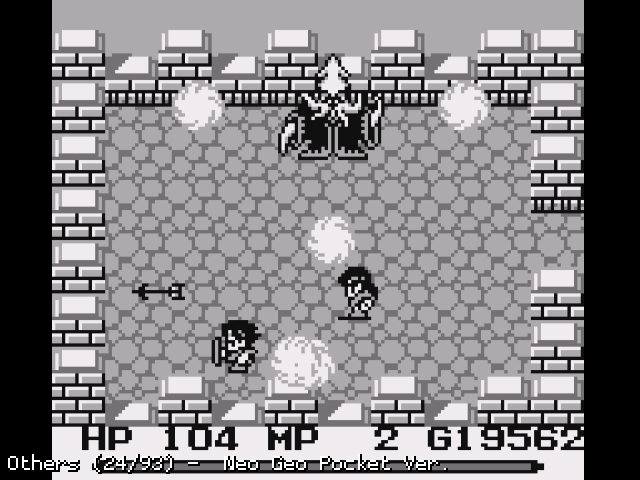
Final Fantasy Adventure’s narrative is about the Mana Tree and the people who are bound to it by destiny. Our adventure begins with the hero, who is named by the player, battling a monster in an arena for the pleasure of the Dark Lord, who is of course the villain of the game. Not long after that, during the hero’s escape from their imprisonment, we learn that the Dark Lord is searching for the key to the Mana Sanctuary, so he can control the Mana Tree. The Mana Tree is the source of the world’s life force, so it is of course what the Dark Lord wants to control. A couple of twists and turns keep the story interesting and really quite engaging, which is saying something since early Game Boy games are not necessarily known for their grand and sweeping narratives. While the story is not going to win any awards, it is more than enough for a handheld adventure, and more than enough to keep me engaged and excited to see where things were going next. I think that the story here is well worth experiencing, and once you bring everything Final Fantasy Adventure has to offer together, you get one of the highlights of the Game Boy’s extensive library.
The Secret of Mana to Come
The Final Fantasy Adventure is not only a fantastic start to the Mana series, but also a solid game all on its own. With a phenomenal combat system and an intriguing story, Seiken Densetsu is a Game Boy title that should be played by anyone who is a fan of not only the Mana series, but action RPGs as a whole. There are more than a few remakes and reimagining’s of this title, and I hope to get to them one day, but I feel that the Game Boy original is well worth playing to this day, because it 100% stands the test of time. The foundation this title laid for the series to come makes Final Fantasy Adventure a touchstone game, and one that more people need to play and love.